Saturday, March 19, 2011

Preparedness Challenge

A fellow blogger (and a person who has blessed me abundantly) over at Homestead Revival has started a Preparedness Challenge. I have decided to take on her challenge as well, and I encourage any of my readers to do the same! It's never a bad thing to be prepared, and if you have ever thought about getting into storing and putting up food in case of emergency, this would be an excellent place to start!

Below is her post:


A Call To Be Prepared

Well, I've held my peace for about as long as I can stand it. Watching the devastation of the earthquake in Japan, followed by a horrific tsunami, and now a nuclear disaster, it's pretty much a no brainer that it would be wise to be prepared.


Those that were closest to the epicenter, tsunami, and reactors have suffered greatly and now the possibility of hypothermia, dehydration, and starvation are very real perils looming in the horizon. My heartfelt prayers goes out to them and I hope that a hand of mercy reaches them in time! 


Preparedness, Definition: refers to the state of being prepared for specific or unpredictable events or situations. Preparedness is an important quality in achieving goals and in avoiding and mitigating negative outcomes. (wikipedia)


Grant it, you can prepare all you want, but sometimes you can still lose all that you've stored. But imagine with me for a minute... what if everyone in Japan had been prepared ahead of time with food and water? How would this scenario been different? Would it have been?


Is it possible that those who did loose everything could be helped by those somewhat locally that still had what they put aside. Yes, the cavalry would still need to come in and lend a hand, but would they have enough to keep them alive until that time if most had some kind of food and water stored? Let's just say that the odds would certainly have been better!


Photo: USA Emergency Supply


The reality is... in our modern, disposable, consumer minded, global society, storing food and supplies is not the norm. Yes, a few cultures may still do this, but I can't think of any off hand (please let me know if you can think of some!). 


Understand that I am not writing this to be judgmental of the Japanese people! I have been duly impressed with how they've conducted themselves in their hour of trial. (Even more impressive when you know that about only one percent are Christian believers!) Sadly, I'm not sure Americans would have been as self controlled if we had been in their shoes. No looting or rioting; no pushing or shoving in lines... 


Update: I've had a reader inquire as to my statement that non-Christians should act so self controlled. Let me clarify... It is certainly possible for non-believers to act in a self-controlled manner. You're seeing proof of it when you watch the Japanese people. Without the Holy Spirit, this is very impressive, because the flesh is powerful indeed. It is to the shame of many Christians that we often do not act in a self controlled manner; but then again, one can be Christian in name only.


Let me get to my point here. I need to be more prepared than I am. There is more I could and should do. How about you? Anyone need a little push to get prepared? Maybe you've talked about it but have done very little? Perhaps you're well on your way and could encourage others to do some prepping?


I'm going to offer a simple call to do one thing each week to get prepared. Every Saturday, I'm going to put up a post to remind everyone of the challenge, but YOU get to pick what you do. To help hold us accountable, you can leave a comment telling what you've done that week or you can write a post and link up. 


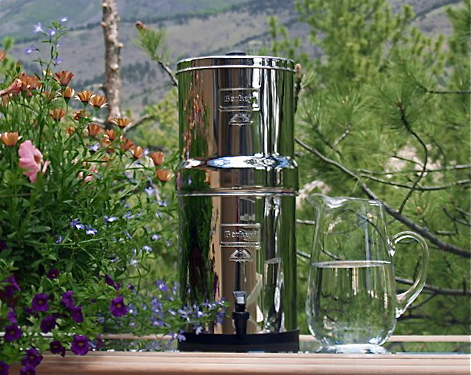
Photo: Big Berkey 


Do not feel like you must do something major each week. Even something small, such as buying a first aid kit, adding some water bottles to the pantry, or buying and planting an extra packet of seeds to grow extra food - it all counts and adds up over time! All I ask is that you clearly state what you did that week. For example, "This week, for the Preparedness Challenge, I bought an extra bag of rice from the co-op and stored it in mylar bags in a bucket". Then you can expound on it more if you'd like. 


Simple enough? I'm already shaking in my boots because I know this is really going to push me to be on the ball! I don't go to town but once or twice a week, and often I'm rushed to get things done, but I need this as much as anybody. Good thoughts of storing food doesn't make it happen. Action does. 


So, are you in? We start tomorrow!


Now, she posted that yesterday as you can see by visiting her WONDERFUL blog, so that makes today the first week of the Preparedness Challenge. :-D


For this week's challenge, all you need to do is complete this sentence...

"This week, for the Preparedness Challenge, I ___________."

You can leave a comment below with more details about how you met the Preparedness Challenge in your home. I would love to hear your ideas!

For me...

This week, for the Preparedness Challenge, I purchased a few extra bags of dry rice and beans for putting up. :-)

What did you do?

Thursday, March 17, 2011

Flu & Cold Season "FLU BUSTER"


1 cup of each: grated horseradish root; diced & peeled garlic cloves; diced onion; grated ginger root; finely chopped HOT peppers, without seeds(habanero/jalapeno, or similar)
32 oz. organic cider vinegar(organic is best if you can get it)
 
Place all ingredients in blender and add enough vinegar to be able to puree into a mash.
 
Pour mixture into large glass bowl, add remaining vinegar and cover with lid. (you should have 1.5 quarts) I use my Pampered Chef 8 cup glass mixing bowl with lid and it works just great)
 
Shake or stir daily.
 
Let sit for 2-4 weeks, then strain through unbleached coffee filter.
 
Bottle liquid in glass jar, and store in dark cupboard....this liquid is ready to use....it gets better as it ages!
 
Now, put the reserved 'mash' back into the glass jar and add another 32 oz bottle of vinegar and start the process all over again to get a second bottle of Super Tonic.
 
 Dosage; Drink 1 oz - 3 times daily if you are coming down with a cold or flu. We put ours in a mug; add hot water and honey to taste. But, if you're brave, you can just drink the tonic straight...drink, gargle, swallow :)
As a daily preventative, put 1 Tbsp in a cup, add hot water and honey to taste.
 

Wednesday, March 16, 2011

RIP Baby Chicks

Well, last night something broke into the "coop" and killed all of our chickens. Well, six confirmed, two we still can't find, but it seems unlikely that they would go far on their own accord. Anyone who owns chickens knows what I'm talking about, especially at night. So goes the life.

Saturday, March 12, 2011

8 New Family Members!

We have added eight new family members to the headcount here in the Teasley Household!

We think we have two Buff Orpingtons, two Golden Comets, two Australorp, and two Silver Laced Wyandottes. (Any opinions on which are which? lol) All pullets, and they will be our laying hens. :-)


The children have already adopted them as our own, and are very excited to have chickens again.

These chickens were purchased locally from our own hometown farmers and small business owners.

Looking forward to some nice fresh eggs this summer!

Monday, March 7, 2011

The Best Commercial Soap

I know that I post a lot on this blog about organic soaps, making your own soaps, buying organic, locally made soaps, but rest assured that I am compassionate to situations and I am honest with myself as well. These options just aren't feasible for people on a moderate to low income, especially in this economy. Soap-making is no easy task either, which makes it a bit difficult for the already over-scheduled woman to do.

I get that, I really do.

If you want a glimpse into MY life, there are a lot of organics that we don't buy simply for money reasons. I know that you cant put a price on good health, as they say, but if I can't grow it or make it myself, we usually don't buy it organic. I'm sure a majority of my readers can understand. :-)

SO, It has been laid on my heart to bring to you the best commercial options for soaps and shampoos for those on a non-organic budget.
First we will look at bar soaps:

There are SO MANY dangerous ingredients in soaps today that it is downright scary! Enough to make one (like me) want to wash with just hot water! Let's look at a popular commercial soap first:

The Dove Beauty Bar.


White is the most simple form of this one. It's their "regular" bar soap. The ingredients are questionable. For those looking for a vegan soap, this is not the soap for you. It has Sodium Tallowate in it which is a rendered animal tallow. That's not bad in my eyes, but vegan shoppers be aware. They do not advertise this.

The complete ingredients list is as follows:

"Sodium Cocoyl Isethionate, Stearic Acid, Coconut Acid, Sodium Tallowate, Water, Sodium Isethionate, Sodium Stearate, Cocamidopropyl Betaine, Sodium Cocoate, Palm Kernelate, Fragrance (Parfum), Sodium Chloride, Tetrasodium EDTA, Trisodium Etidronate, BHT, Titanium Dioxide (CI 77891), Sodium Dodecylbenzene Sulfonate"

Sodium Cocoyl Isethionate is a fatty acid/coconut oil mixture. It's basically safe. It cleans the skin and hair by helping water to mix with oil and dirt so that they can be rinsed away, basically like a binder.

Stearic Acid is another fatty acid derivation from animal and vegetable fats that is "found commonly in many foods" and is added to soaps as a cleansing and emulsifying agent.

Sodium Isethionate is a biodegradable and high foaming detergent used in soaps to make it lather up well. It is not classified as having an adverse health effect on humans.

Cocamidopropyl Betaine is a synthetic detergent added to the soap to make it a little milder on the skin, but it poses no great risk in itself.

Fragrance (Parfum) is a BIG deal that looks so small. Fragrance can be ANYTHING added to get the smell that they want, ANY chemical, synthetic ingredient, or chemical combination. There is a lot of undisclosed gray area in that labeling.

Sodium Chloride is salt, plain and simple.

Tetrasodium EDTA is a questionable ingredient. It's "proper" name is Ethylenediaminetetraacetic acid, and it is synthesised from ethylenediamine (1,2-diaminoethane), formaldehyde, and sodium cyanide. WHOA! Formaldehyde?? "Formaldehyde has been classified as a known human carcinogen (cancer-causing substance) by the International Agency for Research on Cancer and as a probable human carcinogen by the U.S. Environmental Protection Agency" Sodium Cyanide??? Sodium cyanide is "a white poisonous salt (NaCN) used in electroplating." It is a poisonous chemical used to cause one metal to bond to another metal! Ever heard of cyanide poisoning? Look it up. Do you really want to expose yourself regularly and repeatedly to formaldehyde and cyanide?

Trisodium Etidronate is a preservative and a chelating agent also used in water softeners. This ingredient in particular has caused many adverse reactions in people with Eczema because it is a skin and mucous membrane irritant. Even a lot of "all natural" or "organic" soaps have this ingredient, so read the label! And don't get it in your eyes or mouth when using it.

BHA is another questionable ingredient here. It is a preservative used to prevent the tallow and fats from spoiling, and it is used a lot in foods, so check your food labels too. Even Jello. BHA and BHT are used closesly and interchangeably in a lot of formulations. These two closely related chemicals are added to oil-containing foods to prevent oxidation and retard rancidity. The International Agency for Research on Cancer, part of the World Health Organization, consider BHA to be possibly carcinogenic to humans, and the State of California has listed it as a carcinogen. Some studies show the same cancer causing possibilities for BHT. Do your own research on this, I encourage, but DO the research. Your skin is like a sponge, absorbing everything that is put on it, and rubbed into it. That's why our fingers get pruney when we swim or bathe too long. Our cells absorb until they can't absorb anymore, and all of this can pass directly into the bloodstream. 

Titanium Dioxide is a naturally occurring compound, and for that reason many think it is safe, but arsenic is also a naturally occurring compound, would you bathe in it? From the MSDS: "WARNING! MAY CAUSE IRRITATION TO SKIN, EYES, AND RESPIRATORY TRACT. MAY AFFECT LUNGS. SUSPECT CANCER HAZARD. CONTAINS TITANIUM DIOXIDE, WHICH MAY CAUSE CANCER. Risk of cancer depends on level and duration of exposure. Health Rating: 2 - Moderate (Cancer) Chronic Exposure: Titanium Dioxide may cause cancer in humans." Do the research, and use at your own risk.

Sodium Dodecylbenzene Sulfonate is classified as harmful. I will let you look into that one yourselves.

There is a lot more in soaps that we originally are led to believe, huh? It's a crazy world.

Now, that Dove is a picture of MOST of the commercial soaps on the market. Some (Like Tone, Zest, and Dial) have waaay more dangerous ingredients in them, but that's when you come in and do your own research. Seriously, just Google "MSDS (whatever ingredient you are looking up)" and you will have a wealth of information at your fingertips. Just make sure you get your info from non-cosmetic sources. Never get info from a site trying to sell something. Common sense, I know. :-) If you are on a REALLY tight budget, and you can stand to overlook the fact that Tetrasodium EDTA has possible cancer-causing agents in it, I would recommend the Simply Ivory bar. It has fewer "bad" ingredients in it, the only one really being Tetrasodium EDTA.

 NOTE:  there WILL be a price difference buying soaps to avoid all of these dangerous carcinogenic chemicals.

Now, in my opinion, sometimes buying the best commercial soap comes down to the "lesser of two evils" type deal, so in my past three or so years of research, I have found what I think is the best choice. Well, two choices actually. These companies are getting bigger and are showing up in more places, even Walmart and local grocery stores. The first is:

Dr. Bronner's All-One Hemp Pure-Castile Soap


The ingredients are so simplistic that it is almost funny! 

"Saponified Organic Coconut, Palm, Olive Oils ([Organic] with Retained Glycerin), Water, Hemp Oil (Organic), Jojoba Oil (Organic), Salt, Vitamin E" 

These bars  usually run close to $4.00 each, but that is a small price to pay, I think, and cheaper than some (okay, most) organic options. This particula Dr. Bronner's bar has eight different scents you can choose from: Tea Tree, Rose, Peppermint, Lavender, Eucalyptus, Citrus Orange, Baby-Mild, and Almond. And they smell GREAT if I do say so myself. :-) The Baby-Mild is the unscented bar, and all fragrances are natural. No "parfum". :-)


Runner up goes to: 


Kiss My Face Organics Olive Oil Bar Soap


The ingredients are:

"Saponified Olive Oil, Water, Lavandula Angustifolia (Lavender), Sodium Chloride, Fragrance (Parfum)"  

While this one does contain artificial fragrance, that is basically personal preference. Compared to the rest "out there" this is a soap worthy of the runner up position for best commercial bar soap. Kiss My Face Organics usually run about ten cents cheaper than Dr. Bronner's, but they are in more places than Dr. Bronner's as well, I have discovered. It's about availability to most people, am I right?


So, there you have it, my take on commercial bar soaps. Remember, don't take MY word for it, read labels and investigate yourselves. You may find some things in your own regular soaps that will shock you!  Especially Johnson and Johnson baby soap and shampoo, if you use that on your babies. 

I will do shampoos in a later blog. Stay tuned! :-) 


Tuesday, February 8, 2011

Whole Foods for Whole Health Part ?

What topics would YOU like to hear about in my next post from Shonda Parker's book; Mommy Diagnostics?

Friday, February 4, 2011

10 Skills Needed to Thrive in a Post-Collapse World

by John Bush

Knowledge is something that no one can take from you. It’s the eternal wealth that will help you thrive in a Post-Collapse world.

By: Jeffrey Green from ActivistPost.com

Some experts see the perfect storm emerging for a dramatic collapse of Western civilization claiming we’ve reached environmental, economic, and geopolitical tipping points. Clearly, some skills will be far more valuable than others if this societal breakdown occurs. Sorry bankers, lawyers, and accountants, there won’t be a need for you in a post-collapse world.

Before we quantify the skill sets that will be viable, it is important to define the severity of a “post-collapse” scenario. When taken as a whole, together these tipping points could potentially converge to create a post-apocalyptic Mad Max-type world for the vast majority of humanity. However, given the advanced technology that we possess today, it is unlikely to ever become quite that primitive ever again. Surely there will be pockets of energy and food independence no matter what possible scenario unfolds, but the vast majority may be left to fend for themselves.

It would take a serious cataclysmic earth event like a super volcano, a meteor impact, major electromagnetic pulse event, or dramatic pole shift to affect the entirety of humanity. Man-made events like nuclear war, environmental damage, or total economic collapse, no matter how devastating, will be somewhat isolated and contained to specific areas and populations. Incidentally, every nation or territory that has experienced these man-made catastrophes has roared back to life in less than one generation. The only example of nuclear survival was in Japan, while the largest recent economic collapse was the break-up of the Soviet Union. In both cases those countries went through a very tough period, but ultimately they persevered.

For sake of this article, let’s assume that some level of devastation is caused by each type of tipping point in the United States. Our ever escalating wars finally reach our shores by way of long-range nuclear missiles, total economic collapse occurs rendering the dollar worthless, and we would likely have less electricity and water than Iraq did after Bush’s “shock and awe” campaign. Gasoline and oil supplies would likely be down to a trickle, halting all supply lines of food and other goods to big box stores. Factory farming will be impossible without cheap oil products readily available. The suffering will be dramatic.

The only question will become, how do the citizens react? Both the USSR and early 1950s Japan were far more agrarian, and far less dependent on big box stores than America currently is. American dependence on long supply lines, interconnected yet vulnerable electric grid, and pharmaceutical-based healthcare may lead to a more severe breakdown of society than witnessed in those countries. Although, innovative technology for alternative energy and agriculture practices will play a part in surviving; but they can only help the few with the knowledge, means, and stability to use them. And stability will be in low supply for some time, resulting in only small groups with relative comfort — those who planned for the worse. However, as an optimist, I believe that after the initial chaos Americans will rediscover solidarity for one-another, much like they did after 9/11, but this time it will be more sustained out of absolute necessity.

Many articles have been written about how to survive the coming collapse, or what is needed to survive, but not many articles have been written about what skills will have value in a post-collapse world. Imagine fulfilling human necessity without consistent fuel or electricity, large-scale food production, or fully-stocked pharmacies and hospitals. The only form of wealth in a collapsed civilization is the knowledge and skills to produce something of human value.

Here are 10 invaluable skills that will likely help you sustain yourself in a hand-made local world:

1. Organic Gardening and Seed Saving: Skills involving food production will be the most valuable in a post-collapse society. Learning to grow your own food is a must. Obviously, it is necessary to feed your family, but you will also be able to trade your abundance for other items. Additionally, learning to save seeds will also provide another excellent means of trade.

2. Food Processing and Preservation: Learning to process and preserve foods will be another huge skill in a post-collapse world. Taking seasonal abundance and preserving it for future consumption or trade will be vital. Remember, learning to do this with limited electricity is a must. This can also include learning to brew beer, mead, vinegar, or other alcoholic beverages from meager ingredients.

3. Hunting, Fishing, and Gathering: Learning to fish and hunt is essential to survival. Having the proper gear and training will be priceless after the collapse of modern civilization. Having reference guides for edible plants in your region, repairing weapons, trapping wild game, and fishing are great tools to have if you haven’t the time to learn them now. In regards to weapons, your ability to use them also gives you the skill of working security.

4. Animal Husbandry: Notice the first four categories are related to food production. It’s that important. Just gaining knowledge of one of these categories will give you an invaluable skill to thrive in a post-apocalyptic world. Knowledge of animal husbandry can provide endless amounts of sustainable meat, eggs, and milk to you and your tribe.

5. Construction: Construction skills will be very important in a shattered civilization. These skills, especially without power tools, are not something you learn overnight. If you have some basic skills it may be worth learning a few techniques for building small structures with crude hand tools. There are many books teaching anyone how to build basic cabins, sheds, and composting outhouses.

6. Alternative Energy and Fuels: Having the knowledge to implement alternative energy systems will make you a wealthy survivor in a “dark” world. You can learn to build your own alternative energy systems, or you can purchase back up solar generators in preparation for emergencies. There are also small fuel refinery systems available like the biodiesel Fuelmeister, and the new invention from Japan that turns plastic into oil. Knowledge of how to create energy would be invaluable when oil is scarce.

7. Water Purification: Since it’s difficult to pump well water without electricity and with surface water likely to be contaminated, clean water will be in very limited supply. Learning to purify waterwill allow you thrive during this time. You can also purchase water filters for your go-bag that will last weeks, and you can have back-up tablets should you need them. However, the skill and knowledge to purify water should be the goal as that can never run out.

8. Basic First Aid and Natural Medicine: This is another skill that can take years to develop and learn, but that will be crucial when supply lines of pharmaceuticals are cut off and hospitals are over-run. Knowledge of growing herbal gardens for making medicine at home will prove to be very important. Learning basic procedures for stitching wounds, CPR, and more will also be of great assistance. Being the tribe’s shaman with a natural medicine chest is a prestigious position.

9. Mechanics: Mechanics for cars, motorcycles, tractors and other machinery will likely be in high demand. In addition, bicycle mechanics will also fair well in world where fuel is very expensive or hard to come by. These are also skills that are not learned over night, but it will be wise to at least have access to books or how-to videos.

10. Soap and Candle Making: With long supply lines decimated and electricity on the fritz, soap and candle makers will provide a valuable product. Clearly some preparation of storing raw materials may be needed to achieve trade-able levels of these goods. Even if you just had the knowledge to make soap or candles just for your immediate tribe, you will be much better off for it.

You’ll notice that many of these skills also fall into the category of what you would need to be self-sufficient. Again, learning all of these skills will be virtually impossible, especially if the collapse isn’t that far off as many predict. Determine which skills that most appeal to you and focus on them by studying and acquiring the tools needed. Since you can’t become an expert in everything it may be wise to recruit tribe members with various survival skills. It will also be beneficial to build up your library of “how to” books and videos for tasks that you are not proficient in. You can download any video from Youtube by using Keepvid.com and build your library into an external hard drive.

Remember, knowledge of and skills to produce human necessities will be the only form of wealth creation in a hand-made world. Knowledge is something that no one can take from you. It’s the eternal wealth that will help you thrive in a Post-Collapse world. Get Prepared Now!

Source:
http://f4fs.org/10-skills-needed-to-thrive-in-a-post-collapse-world/